Alzheimer's disease can't wait: the economic case for Europe to act now (Guest blog)
15.09.26
As we mark World Alzheimer's Month, attention is once again focused on the millions of people across Europe affected by dementia.
As we mark World Alzheimer's Month, attention is once again focused on the millions of people across Europe affected by Alzheimer's disease and other dementias. Alzheimer’s disease (AD) is at a turning point in Europe, with breakthroughs in therapies and diagnostics having the potential to transform approaches to care and management of the disease. Despite growing recognition of the need for comprehensive policy action to tackle AD, current efforts across Europe remain insufficient.
A new report, Assessing the economic case for Alzheimer’s disease policy prioritisation, authored by Charles River Associates (CRA) and funded by Biogen, has set out the potential socioeconomic benefits from action to enable timely diagnosis and treatment at scale. Specifically, potential socioeconomic benefits from widespread and effective AD policy prioritisation could cumulatively reach €182 billion for France, Germany, Italy, Spain, and the UK (EU4/UK) from 2026 to 2036.
A burden that is large – and growing fast
Alzheimer's already exerts an enormous toll on patients, families, caregivers and health and care systems. The report estimated the total socioeconomic burden of AD across EU4/UK at €552 billion in 2026. The burden rises sharply as patients progress: the per-person cost of severe AD is almost four times that of mild cognitive impairment (MCI).
Left unaddressed, the trajectory is stark. As the number of people living with AD in these five countries climbs from 14.8 to 18.3 million, the annual burden is projected to more than double within a decade, surpassing €1 trillion by 2036 – an increase of nearly €500 billion a year within a decade.
The value lies in slowing progression
Yet the research also points to a more hopeful outlook: with the right policy action now, Europe could reduce the socioeconomic burden of Alzheimer’s disease by €182 billion over the next decade.
The economic case for AD policy prioritisation rests on a simple mechanism: keeping people in the earlier, less costly stages of disease reduces the overall burden on patients and society. By modelling a scenario of widespread, active and effective policy prioritisation – where patients benefit from timely diagnosis and access to disease-modifying therapies – there could be 430,000 fewer people living with severe AD by 2036, and 1.4 million more people remaining in the MCI stage, compared with a no-change baseline.
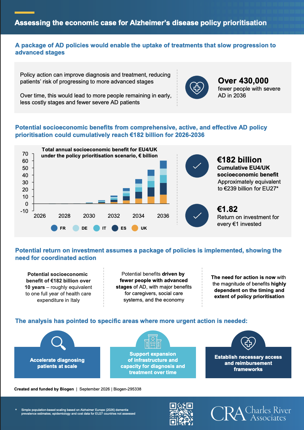
Because the costs of advanced disease per individual are so much higher, these shifts compound over time. Annual socioeconomic benefits accelerate from modest early gains to €60 billion a year by 2036, and the accumulated benefits would be roughly equivalent to a full year of healthcare expenditure in Italy. The return on investment (ROI) to generate this saving is €1.82 for every €1 invested.
The report also found that the potential benefits shrank dramatically in scenarios of delayed or partial action, showing the importance of acting now. As Europe’s population ages, timely policy action will be essential to ease the growing burden on patients, families, caregivers, healthcare systems and economies.
Unlocking the potential benefits: three priorities for action
Realising this value depends on a coordinated package of policy action, as no single policy change will be sufficient. Progress requires a coordinated approach. The analysis points to three areas where more urgent
action is needed:
The time for action in Europe is now. Breakthroughs in science and innovation present a huge opportunity to transform how AD is managed. The potential socioeconomic benefits of AD policy prioritisation will only be realised through coordinated, widespread action – and close collaboration across all stakeholders to deliver it.
For too long, Alzheimer’s disease has been viewed primarily as an inevitable consequence of ageing. Today, that perspective must evolve, with policy keeping pace with scientific progress.
This World Alzheimer's Month should serve as a reminder that progress depends not only on scientific innovation, but also on policy leadership. The science is advancing, the evidence is compelling, and Europe now has an opportunity to act decisively. By accelerating diagnosis, strengthening healthcare system readiness and enabling access to innovation, policymakers can help transform outcomes for people living with Alzheimer's disease while reducing the growing burden on society.
The science is advancing rapidly. The challenge now is to ensure that European policy keeps pace.

