From approval to access: Why uptake of new cancer medicines still varies across Europe (Guest blog)
08.10.26
Scientific breakthroughs and regulatory approvals are critical milestones in cancer care, but they are not the end of the journey. For patients, access begins only when new medicines are actually used in clinical practice.
Scientific breakthroughs and regulatory approvals are critical milestones in cancer care, but they are not the end of the journey. For patients, access begins only when new medicines are actually used in clinical practice. The Comparator Report on Cancer in Europe 2025 by the Swedish Institute for Health Economics (IHE) emphasizes that uptake – not regulatory approval or reimbursement alone – ultimately determines patient benefit.
The report shows a mixed picture: disparities in uptake of new cancer medicines remain substantial, but they have narrowed over time, and the traditional East–West divide is increasingly blurred.
Approval is only the first step
After European Medicines Agency (EMA) approval, national pricing and reimbursement decisions must be made. For more than a decade, the EFPIA Patients W.A.I.T. Indicator Survey has documented large discrepancies between countries in both the proportion of EMA-approved medicines that are reimbursed and the time to reimbursement.
Even once reimbursement is granted, access is not immediate. Medicines often need to be incorporated into clinical guidelines before routine use. In some countries, such as Italy, Spain, and Sweden, subnational or regional approvals are required in addition to (or instead of) national decisions, creating further delays.
Large differences in uptake – but some convergence
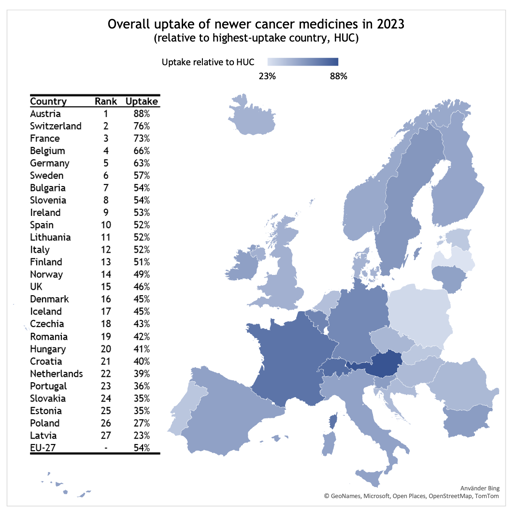
In 2023, uptake of new cancer medicines (measured as milligrams used per cancer case) was highest in Austria and Switzerland and lowest in Latvia and Poland. Germany, which consistently ranks first in the EFPIA Patients W.A.I.T. Indicator Survey, only reached fifth place, demonstrating that a favorable reimbursement environment does not necessarily lead to high uptake.
Across twelve cancer types and product classes, there was a three-fold difference between the highest- and lowest-uptake countries. While still substantial, this marks progress: in 2018, the gap was more than five-fold.
Breast cancer showed the most even uptake across countries in 2023, whereas lung cancer displayed the greatest variation. For lung cancer and gynecologic cancers, a clearer regional divide emerged, with lower uptake in several Central and Eastern European countries. This aligns with more limited availability of advanced biomarker testing in parts of the region.
The East-West divide in uptake is crumbling
Earlier Comparator Reports highlighted stark disparities across Europe. Historically, Western European countries provided faster and broader access to innovative cancer medicines, while many Central and Eastern European countries lagged behind.
The new analysis confirms that differences remain, but the pattern is no longer clear-cut. Several Central and Eastern European countries have made notable progress. Slovenia stands out as an example of impressive catch-up, now ranking closer to higher-access countries. At the same time, some Western European countries have slipped. Portugal and the Netherlands are now closer to the lower end of the uptake ranking. Increasingly, disparities reflect national policy choices and system capacity rather than geography and economic wealth alone.
Differences in the Big Five Countries
Variation is also evident among Europe’s five largest pharmaceutical markets: Germany, France, Italy, Spain, and the UK.
France and Germany typically show the fastest and broadest uptake of newly approved cancer medicines. By contrast, the UK has persistently ranked lower. Rigorous health technology assessment processes, stricter cost-effectiveness thresholds, and centralized budget controls may contribute to slower or more selective adoption.
Italy and Spain tend to fall in between, with uptake levels below Germany and France but generally above the UK. These differences illustrate that even among large, high-income health systems, institutional frameworks clearly shape patient access.
The cost of delayed adoption
Delayed adoption of effective cancer medicines is not merely administrative. It carries an opportunity cost. When new treatments that extend survival or improve quality of life are introduced more slowly, patients may lose potential life years - with corresponding societal losses in productivity.
Earlier blogs in this series showed that investment in cancer care has translated into measurable survival gains. Timely uptake of innovation is essential to sustain that progress.
From authorization to implementation
The Comparator Report underscores that innovation in oncology is accelerating. But innovation delivers value only when it reaches patients.
Policy efforts therefore need to focus not only on research, regulatory approval, and reimbursement, but also on implementation capacity. This includes aligning reimbursement of medicines and companion diagnostics, expanding diagnostic infrastructure, investing in workforce training and retention, ensuring regularly updated national treatment guidelines with monitoring of prescribing patterns, as well as sufficient budgets to prescribe reimbursed medicines to all eligible patients.
Europe has narrowed the uptake gap. Yet a more than threefold difference between countries in 2023 shows that equitable access to cancer innovation remains unfinished business.
Key takeaways:
Graph based on Figure 91 in the Comparator Report
Related blogs
