How to fix the conundrum of Europe’s East–West healthcare divide
14.04.26
Patients in Central and Eastern Europe (CEE) have, for many years, faced an uneven playing field in access to medicines. While some countries in this region have made progress in improving the investment in health and modernising their healthcare systems, differences in access to innovative treatments and consequently in health outcomes and life expectancy continues to persist and requires sustained attention.
Patients in Central and Eastern Europe (CEE) have, for many years, faced an uneven playing field in access to medicines.
While some countries in this region have made progress in improving the investment in health and modernising their healthcare systems, differences in access to innovative treatments and consequently in health outcomes and life expectancy continues to persist and requires sustained attention. Closing this gap is not only a healthcare priority, but an economic and social necessity.
In a study commissioned by EFPIA, academic experts from the CEE region -Dr Slaveyko Djambazov, Dr Luka Voncina, Dr Aleš Rod, and Dr Marcin Czech- highlight this dual reality of progress alongside remaining gaps for healthcare systems. It is particularly evident when you make comparisons with the ‘EU4’ - Germany, France, Italy, and Spain.
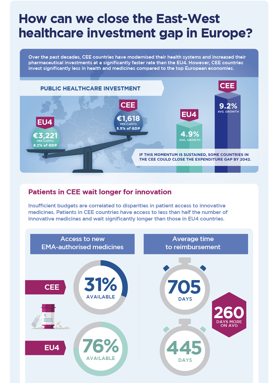
Data shows that CEE governments invest a smaller share of GDP on health, with a structural -investment gap compared to Western Europe. For instance, in 2023 public healthcare investments averaged €1,618 per capita in the CEE region versus €3,221 in the EU4 – around half the EU4 level.
The study indicates that while there have been some improvements in the last years, health outcomes mirror the investment gap: compared with EU4, the CEE region has 5-year lower average life expectancy and records ~137% higher treatable mortality. Further improvements remain achievable with sustained investment and policy focus.
Recent strong growth demonstrates there is a positive link between health investment and economic performance
Public health and pharmaceutical spending in the CEE are growing faster than in EU4, and in several CEE countries could reach today’s EU4 levels within the next two decades if current trends are maintained.
Country specific analysis shows, for example, that Czechia and Slovenia are the countries closest to spending when it comes to the EU average health investment (~7%) and exhibit comparatively higher GDP per capita among CEE peers. This shows that there is a positive link between health investment and economic performance. Increases in health investments can be a lever to strengthen labor participation, reduce disease burden, and enhance productivity.
If growth rates are sustained, four countries—Slovenia, Poland, Croatia, and Bulgaria—are projected to reach EU4 average investment levels by 2040. The pace of convergence will vary: Hungary, Romania, and Latvia would benefit from additional targeted investment efforts to accelerate progress.
The report also highlights that while growth is noted, it needs to be further developed by sustained, country-specific policy commitments. Healthcare financing should be treated as a strategic, long-term investment that supports growth, productivity, and fiscal stability, rather than a short-term cost.
Still CEE countries see poor access to innovation
There is irrefutable evidence that shows that access to innovation across Europe is a geographical lottery. Some patients wait, on average, ten times longer than others to access new medicines.
Between 2020 and 2023, patients in CEE on average gained reimbursed access to only 31% of new EMA-authorized medicines, compared with 76% in the EU4. The average time from EMA authorization to reimbursement was 705 days in CEE – 260 days longer than the EU4 average of 445 days.
Governments across the CEE increasingly rely on high clawbacks and mandatory rebates to contain medicines spending. In 2023, industry contributions in clawbacks and taxes reached 30.4% in Hungary, 25.8% in Romania; 23.5% in Bulgaria and 22.8% in Croatia. The recent exponential increase of clawbacks reflects a structural underbudgeting trend and calls for more sustainable funding mechanisms in line with economic growth, population growth and ageing, burden of disease and opportunity costs.
Demographic challenges and aging population increases pressure on healthcare spending and threatens fiscal sustainability and economic growth
CEE health systems are also facing increased pressure from demographic challenges, population ageing and rising prevalence of chronic diseases.
By 2050, the working-age population (15-64) in CEE is projected to fall by 12.9 million people (20%), resulting in fewer contributions to compulsory health insurance schemes and an estimated annual tax revenue loss of €14.6 billion. The largest losses in Poland (-€6.7bn), Romania (-€1.9bn), and Lithuania (-€1.6bn).
Healthcare spending increases sharply after the age of 55 and rises approximately threefold. These trends highlight the importance of forward-looking investment and prevention strategies to ensure sustainability.
What if CEE countries invested as much as the EU4 in health?
The difference could be life-changing. Greater investment in healthcare could help save more than 100,000 lives, while also bringing an estimated €300 billion in economic benefits that support stronger, healthier communities.
Failing to increase healthcare investment in CEE carries a substantial human and economic cost. If current spending levels persist, the region is projected to accumulate more than 49 million DALYs and experience over 176,000 preventable deaths annually.
A constructive path forward
Closing the East West gaps requires a strategic and sustained approach to funding, access, and prevention. Therefore, policies to increase their investment in healthcare can simultaneously improve population health and support economic growth as productivity rises.
The report outlines recommendations to close the gap, including supporting forward-looking budget planning and reducing distortionary payback mechanisms, leveraging outcomes-based payment models, strengthening HTA frameworks, and leveraging the outputs of the Joint Clinical Assessment.
Importantly, the CEE region already demonstrates examples of good practice and progress, showing that targeted reforms can deliver results. Through these initiatives, alongside collaborative working at EU & national level, we can significantly reduce disparities in care, improve health outcomes and accelerate economic growth.
Europe should be a region where every patient, regardless of geography, can expect the same opportunities for good health and that is our goal.
Explore the key policies recommendations here.