Every €1 invested in new medicines returns €5.67 to Europe
23.06.26
Economic study on impact of pharmaceutical innovation in Europe reinforces the argument that under-investment in health is a false economy, costing more than it saves.
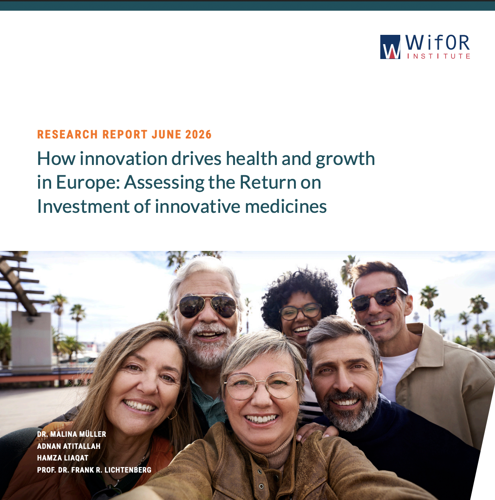
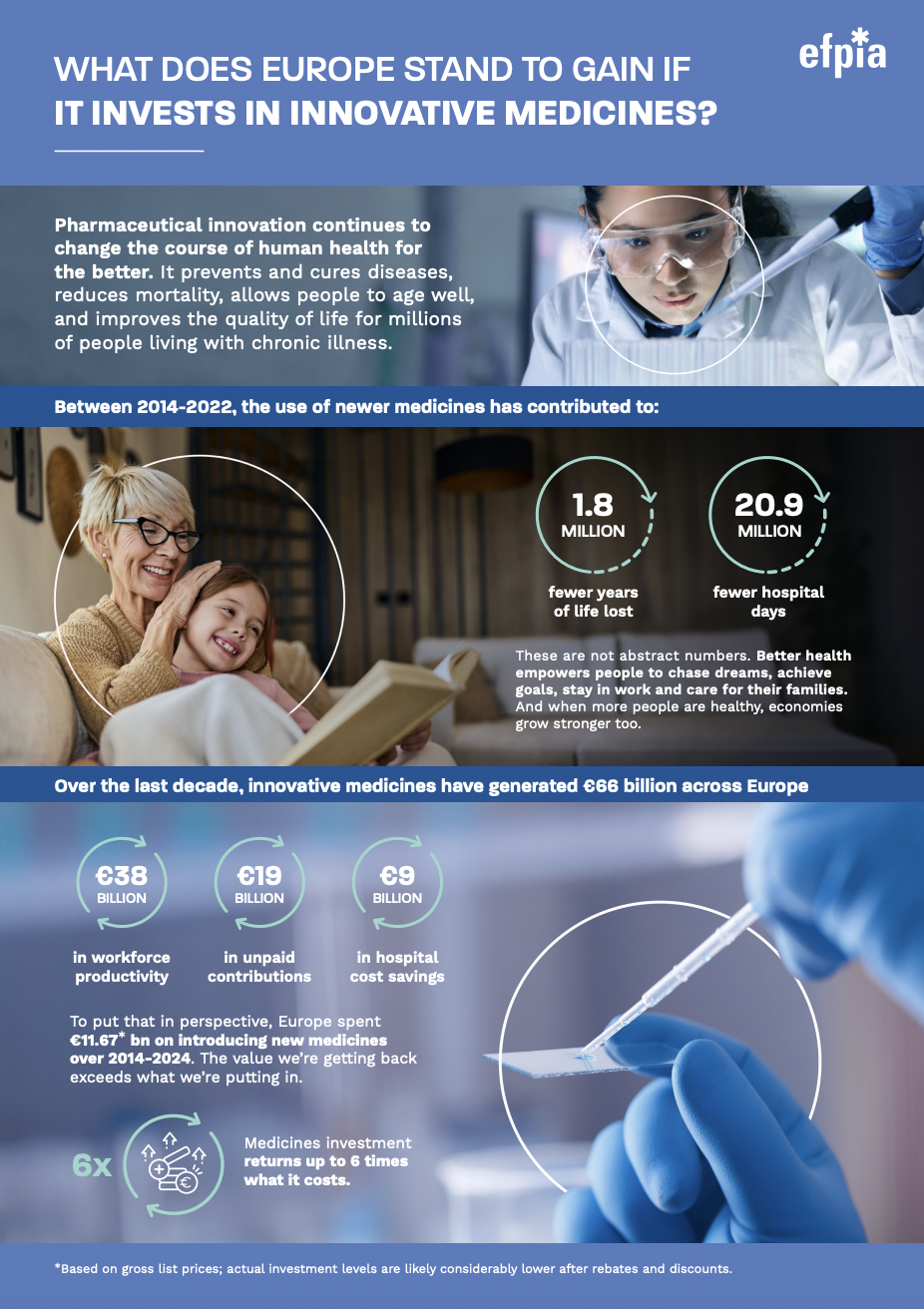
EFPIA has today published a comprehensive study on the social and economic value of pharmaceutical innovation. Data shows that between 2014 and 2024 Europe’s investment of €11.67 billion in new medicines returned more than five times the amount in social, economic and hospital cost savings – equating to €66billion in total, including over €9billion in direct hospital savings.
The study examines impact on mortality and hospital utilisation and quantifies the economic returns based on three major disease areas in 29 European countries between 2014 to 2022. Conducted by WifOR Institute and authored together with Columbia University economist, Professor Frank R. Lichtenberg, the research challenges the perception of healthcare as simply a cost to be contained, and argues instead that policies should reflect the value that innovation brings to health systems and society.
Key findings include:
The report also details the return on investment at country level, showing total social impact, incremental pharmaceutical expenditure, hospitalization savings, and the implied ROI for all 29 countries.
The study shows that that investment in pharmaceutical innovation and timely availability of innovative medicines generates substantial economic and social benefits as well as alleviating workforce capacity constraints in healthcare systems. These benefits are, however, often seen over the longer term or appear outside of health budgets as reduced social care costs, increased tax revenues and reduced sickness benefits.
As a result, Europe continues to pursue short-term cost containment strategies designed to lower medicines spending across Member States rather than an investment strategy which benefits patients, health systems and Europe’s economy. As an example, Europe spends around 1% of GDP on pharmaceuticals compared with 2% in the US and 1.8% in China.
Without commitment to increased spending on innovative medicines, European patients and health systems will experience growing delays in accessing the latest scientific breakthroughs, and the innovation ecosystem will continue to worsen compared with Asia and the US.
Europe continues to struggle to compete for investment compared with global peers: It has lost almost a quarter of its global share of pharmaceutical R&D investment over two decades, and its share of industry sponsored clinical trials has almost halved since 2013. Uncertainties created by global trade and pricing policies are likely to exacerbate the trends.
Policy recommendations
Stefan Oelrich, President, EFPIA, said: "If Europe wants to remain a global leader in life sciences, it must create an environment where innovation can thrive and where patients can benefit from scientific breakthroughs without unnecessary delay. The choices made today will determine whether Europe continues to lead in medical innovation or falls further behind in one of the world's most strategically important sectors."
Nathalie Moll, Director General, EFPIA, said: “This data adds to the growing evidence base that spending in healthcare creates significantly more value than it costs society. Deprioritizing health and medicines budgets is a political choice that is not only a strategic mistake but an economically self-defeating decision which sacrifices long-term prosperity for short-term gains. Many nations now recognise the importance of a healthy society as key to a high-performing economy; Europe should follow suit.”
Notes to editors
Countries included in scope: Austria, Belgium, Bulgaria, Croatia, Czechia, Estonia, Finland, France, Germany, Greece, Hungary, Ireland, Italy, Latvia, Lithuania, Luxembourg, Netherlands, Norway, Poland, Portugal, Romania, Serbia, Slovakia, Slovenia, Spain, Sweden, Switzerland, Türkiye, United Kingdom.
Access: Europeans also wait 500 days, on average, to access a newly authorised medicine, with an 88% disparity in access between countries.
Availability: In 2025, close to half (49%) are not available to patients in Europe – up from 46% in 2019. In 2025, 17% are only available under restricted conditions (6% in 2019). In 2025, the share of medicines fully available on public reimbursement lists has declined substantially to 28%, down from 42% in 2019.